


 Cart
Cart
 sales@molnova.com


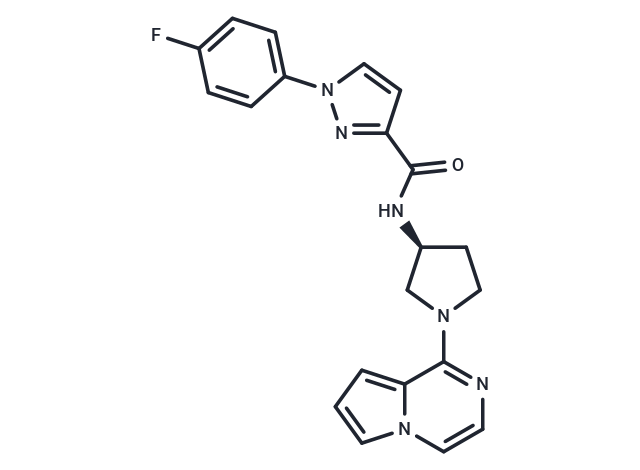
CXCR7 antagonist-1
CAS No. 1613021-99-0
CXCR7 antagonist-1( —— )
Catalog No. M35092 CAS No. 1613021-99-0
CXCR7 antagonist-1 is a specific antagonist of the binding of the SDF-1 chemokine or I-TAC to the chemokine receptor CXCR7.
Purity : >98% (HPLC)
 COA
Datasheet
HNMR
HPLC
MSDS
Handing Instructions
COA
Datasheet
HNMR
HPLC
MSDS
Handing Instructions
| Size | Price / USD | Stock | Quantity |
| 2MG | 286 | Get Quote |


|
| 5MG | 454 | Get Quote |
|
| 10MG | 655 | Get Quote |
|
| 25MG | 994 | Get Quote |
|
| 50MG | 1362 | Get Quote |
|
| 100MG | 1764 | Get Quote |
|
| 500MG | Get Quote | Get Quote |
|
| 1G | Get Quote | Get Quote |
|
Biological Information
-
Product NameCXCR7 antagonist-1
-
NoteResearch use only, not for human use.
-
Brief DescriptionCXCR7 antagonist-1 is a specific antagonist of the binding of the SDF-1 chemokine or I-TAC to the chemokine receptor CXCR7.
-
DescriptionCXCR7 antagonist-1 is a CXCR7 antagonist that inhibits the binding of the SDF-1 chemokine (also known as the CXCL12 chemokine) or I-TAC (also known as CXCL11) to the chemokine receptor CXCR7. CXCR7 antagonist-1 is useful in preventing tumor cell proliferation, tumor formation, inflammatory diseases, and many other diseases (extracted from patent WO2014085490A1, compound 1.128).
-
In Vitro——
-
In Vivo——
-
Synonyms——
-
PathwayAutophagy
-
TargetCXCR
-
RecptorCXCR
-
Research Area——
-
Indication——
Chemical Information
-
CAS Number1613021-99-0
-
Formula Weight390.41
-
Molecular FormulaC21H19FN6O
-
Purity>98% (HPLC)
-
SolubilityIn Vitro:?DMSO : 100 mg/mL (256.14 mM; Ultrasonic )
-
SMILESFc1ccc(cc1)-n1ccc(n1)C(=O)N[C@H]1CCN(C1)c1nccn2cccc12
-
Chemical Name——
Shipping & Storage Information
-
Storage(-20℃)
-
ShippingWith Ice Pack
-
Stability≥ 2 years
Reference
1. Junfa Fan, et al. Cxcr7 antagonists. Patent WO2014085490A1.
molnova catalog



related products
-
USL311
USL311 is a CXCR4 receptor antagonist which prevents the binding of stromal-cell derived factor-1 (SDF-1 or CXCL12) to CXCR4.?USL311 inhibits CXCR4 activation and decreases proliferation and migration of CXCR4-expressing tumor cells, with anti-tumor activity.
-
Syringaresinol-di-O-...
1. Syringaresinol-di-O-glucoside protects the animals from the stress-induced decreases in sex behaviours and in rectal temperature, the stress-induced failure of retrieval of memory, and the stress-induced enlargement of adrenal gland.
-
Inulin
Inulin(Inulin and sodium chloride), a starch found in the tubers and roots of many plants. Since it is hydrolyzable to fructose, it is classified as a fructosan.
